When most people hear “PTSD,” they often think of one traumatic experience, such as a severe accident or violence. But a distinct condition called Complex PTSD develops when trauma is ongoing, and its impact is often not well understood.
For this type of trauma, there’s no clear endpoint. The threat is woven into daily life for months or years, and the brain changes itself to survive.
These changes look different from standard PTSD. They affect how people regulate emotion, how they see themselves, and how safe they feel. Researchers have been working to define this cluster of symptoms for decades. In fact, in 2018, the World Health Organization formally recognized this form of PTSD as a separate diagnosis: Complex PTSD.
What Is Complex PTSD?
Complex PTSD, or C-PTSD (sometimes written as CPTSD), develops when trauma is repeated and prolonged. This is ongoing trauma where there is no option for escape. This trauma typically continues for months or years, and the person experiencing it has no control over when it stops.
Common causes of C-PTSD include:
- Childhood abuse, neglect, or emotional unavailability from a caregiver
- Domestic violence that persists over months or years
- Growing up in a home that felt unpredictable or chronically unsafe
- Ongoing bullying or long-term workplace harassment
The trauma doesn’t have to be physical. Chronic emotional neglect and prolonged unpredictability can reshape the brain with the same force that physical harm does, often more so, because this type of trauma can be harder to understand.
How C-PTSD Differs from PTSD
PTSD and C-PTSD have been recognized as two separate conditions because they don’t respond the same way to treatment. Standard PTSD tends to organize itself around a specific event, with flashbacks, avoidance, and hypervigilance that can usually be traced to one identifiable memory.
C-PTSD goes further. It changes how a person perceives themselves, how much trust feels possible, and how reliably they can regulate their own emotional state. These aren’t personality traits. They’re neurological adaptations built under conditions of prolonged stress.
| PTSD | Complex PTSD | |
| Trauma Source | Includes emotional dysregulation, damaged self-perception, and relational difficulties | Repeated or prolonged trauma |
| Core symptoms | Flashbacks, avoidance, hypervigilance | Includes emotional dysregulation, damaged self-perception, relational difficulties |
| Self-perception | Generally intact | Often severely affected |
| Relationships | Can be strained | Trust is frequently very difficult |
| Dissociation | Possible | Common |
Signs of Complex PTSD
C-PTSD looks different across individuals, but certain patterns appear consistently enough to be recognized.
Emotional dysregulation. Emotions arrive fast and intensely, with little warning, and can be hard to bring back down. Anger, grief, or numbness can shift abruptly and feel disproportionate to the situation at hand.
A persistent negative view of self. This goes beyond low confidence. It’s a deep-seated belief of being broken, worthless, or fundamentally unlike other people, usually accompanied by shame that feels like a permanent state rather than a response to specific events.
Difficulty trusting others. Relationships feel risky even with people who haven’t caused harm. Pulling away, anticipating betrayal, and gravitating toward unsafe dynamics are all common patterns.
Dissociation. Feeling detached from your body, your emotions, or the world around you. This can show up as emotional numbness, difficulty staying present, or a sense of watching your own life from outside it.
Chronic physical symptoms. Fatigue, headaches, gastrointestinal problems, and unexplained pain are common in people with C-PTSD. These symptoms often don’t have a clear physical cause, but the connection between unprocessed trauma and physical health is well-documented.
Persistent hypervigilance. Constantly scanning for threats, even in objectively safe environments. The nervous system stays in alert mode long after the original danger is gone.
Why C-PTSD Often Gets Missed
Many people live with C-PTSD for years before anyone identifies it, and the reasons are fairly consistent. The symptom profile overlaps heavily with depression, anxiety, borderline personality disorder, and bipolar disorder. Receiving one of those diagnoses first, sometimes several of them, is common, and each may be accurate in its own way while still missing the underlying pattern.
C-PTSD is also underrepresented in clinical training. The ICD-11 formalized the diagnosis in 2018, but adoption into everyday clinical practice has been gradual. A clinician who isn’t familiar with C-PTSD as a distinct condition will often route the presentation toward more familiar categories.
If you’ve cycled through multiple treatments with limited progress and your history involves prolonged or repeated trauma, it can be worth asking your provider whether C-PTSD might be part of what’s happening.
What Happens in the Brain with Complex PTSD
When trauma is prolonged and inescapable, the brain doesn’t just store an experience. It restructures itself around the threat. Threat-detection circuitry stays chronically activated, emotion regulation pathways are disrupted, and the brain regions responsible for integrating memory and maintaining a coherent sense of self lose their normal functioning.
A foundational 2000 fMRI study by Hariri, Bookheimer, and Mazziotta at UCLA’s Brain Mapping Division demonstrated that simply labeling an emotional state changes the brain’s response to it, reducing amygdala activation and shifting processing toward the prefrontal cortex. That finding helped establish how much neurological flexibility is possible when the right conditions are created.
The challenge with C-PTSD is that the nervous system has been locked into survival patterns for so long that standard therapies struggle to create those conditions. The brain isn’t rigid because therapy isn’t working well enough. Therapy isn’t working as well because the brain is too rigid to receive it.
Why Standard PTSD Treatments Don’t Always Work for C-PTSD
First-line approaches for PTSD include prolonged exposure therapy, EMDR, and SSRIs. These work for many people and are often the right starting point. For C-PTSD, though, results tend to be more limited. When survival patterns are deeply entrenched, the neurological flexibility needed for new learning becomes harder to access through talk-based approaches alone.
Treatment for standard PTSD typically moves into trauma processing relatively quickly. C-PTSD usually requires a different sequence. Most clinical guidelines recommend a phased approach: starting with stabilization and emotion regulation skills before any direct trauma processing begins. Rushing into trauma-focused work without that foundation can be destabilizing rather than helpful.
This means treatment for C-PTSD tends to be longer, more focused on building regulatory capacity first, and often incorporates modalities like Dialectical Behaviour Therapy (DBT) or schema therapy alongside trauma work. The challenge is that even this phased approach can stall when the nervous system stays too dysregulated to hold new learning between sessions.
IV psychedelic therapy has been shown to be effective for both PTSD and C-PTSD. For C-PTSD specifically, the neuroplasticity mechanism may be particularly valuable, because it can create enough of a shift in nervous system rigidity to make the stabilization work actually possible.
How IV Psychedelic Therapy May Help
IV psychedelic therapy works through a different mechanism than antidepressants or traditional therapy. Rather than gradually adjusting neurotransmitter levels over weeks, IV infusions can produce a rapid shift in neuroplasticity, temporarily making the brain more open to forming new connections and loosening rigid old ones.
Research published in JAMA Psychiatry (Feder et al., 2014) found that a single IV infusion produced significant reductions in PTSD symptom severity compared to placebo, with effects measurable within 24 hours and sustained for at least a week. For people with C-PTSD specifically, this period of increased neuroplasticity can allow therapy to do what it couldn’t before. It doesn’t erase the past, but it can reduce the rigidity that keeps survival patterns locked in place, creating an opening for therapeutic work.
What the Research Shows
The evidence for IV therapy in PTSD and related conditions has expanded substantially over the past decade. A 2021 randomized controlled trial (Feder et al., American Journal of Psychiatry) found that repeated IV infusions produced significant reductions in PTSD severity compared to placebo, with improvement sustained over a two-week treatment period. Research published in Frontiers in Psychiatry found that IV-based treatment embedded in a structured clinical program significantly reduced PTSD and depression severity in people with treatment-resistant presentations.
While there are currently no large-scale trials that have studied IV therapy specifically in C-PTSD population as the diagnosis is so new, there is extensive evidence on its effectiveness for PTSD.
The neuroplasticity window created by IV therapy may be particularly valuable for C-PTSD because it increases neuroplasticity, so the brain becomes more flexible and easier to afdapt. As stuck patterns begin to loosen, you may feel more grounded, more present, and more able to engage with life, relationships, and therapy.
The research consistently support IV psychedelic therapy as an evidence-based option when standard treatments haven’t gone far enough.
Do You Need a Formal Diagnosis?
No. At Ketamind Health, a formal C-PTSD diagnosis isn’t required to explore whether treatment is appropriate for you. What we do require is a thorough assessment covering your history, your current symptoms, your medications, and your goals. That assessment tells us whether IV psychedelic therapy is a safe and appropriate fit, and what a structured plan would look like for your specific situation.
What Care at Ketamind Health Looks Like
For people in Toronto, the GTA, and across Ontario exploring care for C-PTSD or treatment-resistant PTSD, this is how the treatment process typically works:
Complimentary consultation. A no-pressure conversation to understand your history and answer your questions.
Medical screening. A thorough clinical assessment should be conducted before any treatment begins.
Personalized infusion protocol. Dosing and session structure tailored to your individual history and profile.
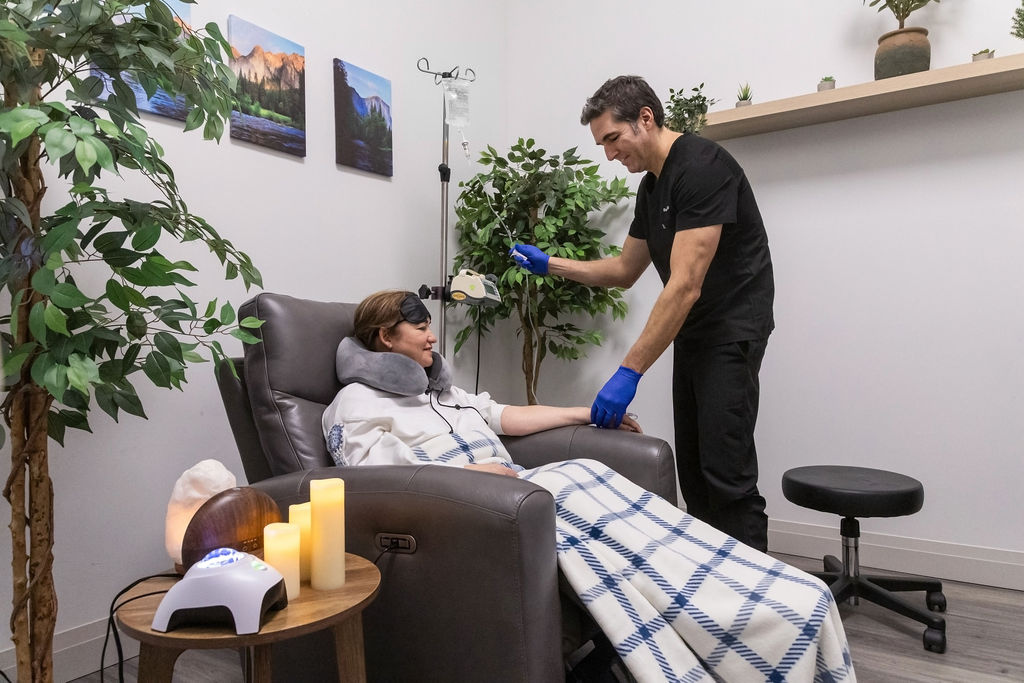
Continuous monitoring. A registered nurse is present throughout every infusion, with direct visual access to every treatment room at all times.
Follow-up and support. We help connect you with a therapist who can support the psychedelic process and build on what treatment opens up.
Care at Ketamind Health is led by Dr. Darren Ezer and Dr. Mansour Moosavi, both Royal College-certified anesthesiologists, with psychiatric oversight from Dr. Brian Kirsh. Every infusion is physician-initiated and personally overseen from start to finish.
Is IV Psychedelic Therapy Right for You?
IV psychedelic therapy isn’t the right fit for everyone. Some people do well with therapy alone, medication adjustments, or other structured approaches. But if you’ve been working at this for a long time and standard treatments haven’t moved things forward, it’s worth asking whether a different mechanism might be what’s needed.
C-PTSD is a neurological injury, not a character flaw or a failure of effort. It responds to treatment when that treatment goes deep enough. If you’re in Toronto, the GTA, or anywhere in Ontario, book a complimentary consultation with our team, or call us at (416) 343-0074.
Frequently Asked Questions About Complex PTSD
Is Complex PTSD in the DSM-5? No. Complex PTSD is recognized in the ICD-11, published by the World Health Organization in 2018, but it isn’t listed as a separate diagnosis in the DSM-5. This is one reason it’s frequently misdiagnosed as depression, borderline personality disorder, or anxiety. A clinician working from DSM-5 criteria alone may miss the C-PTSD pattern entirely.
What’s the difference between PTSD and Complex PTSD? Standard PTSD typically develops after a single traumatic event and tends to organize around specific memories, flashbacks, and avoidance. Complex PTSD develops from repeated or prolonged trauma with no escape, and goes further in its effects. It changes how a person regulates emotion, perceives themselves, and relates to others in ways that standard PTSD does not.
Can Complex PTSD be treated? Yes. C-PTSD responds to treatment, though it typically requires a longer, phased approach than standard PTSD. Treatment usually begins with stabilization and emotion regulation skills before trauma processing begins. For people whose nervous system has stayed too dysregulated to hold progress between sessions, IV psychedelic therapy may help create the neurological flexibility needed for that work to take hold.
How long does treatment for Complex PTSD take? There’s no single answer, because C-PTSD varies significantly in severity and history. Most people require longer treatment than standard PTSD, often measured in months to years rather than weeks. IV psychedelic therapy doesn’t replace that work, but for some people, it meaningfully accelerates what’s possible within it.
This article is for educational purposes only and does not constitute medical advice, diagnosis, or treatment. Always consult a qualified healthcare professional regarding your mental health care. If you are experiencing a mental health crisis, call 911 or text 988 to reach the Suicide Crisis Helpline.