If you are searching for alternatives to antidepressants, there is a good chance you’ve already looked into standard depression treatment options. Maybe you took one or more antidepressants, and the medication helped a little, but not enough. Perhaps the side effects were difficult to live with. You may have also tried talk therapy, which helped you understand your depression, but your mood, energy, and sense of connection still did not return.
This experience can feel lonely, but it’s not rare. Antidepressants help many people, yet they don’t work well enough for everyone. In the large STAR*D depression study, about one-third of participants reached remission after the first antidepressant treatment step, while others needed additional treatment steps or still did not reach full remission.
In Canada, treatment-resistant depression is also a major concern. Canada’s Drug Agency notes that about 22% of people in Canada with depression have treatment-resistant depression, which means that depression symptoms have not improved enough after typical medication approaches.
At Ketamind Health, we work with people from Toronto and across Ontario who are looking for a medically supervised option after conventional care has not provided enough relief. This article explains why antidepressants and therapy may not be enough for some people, what treatment-resistant depression means, and how IV ketamine therapy may fit into a careful, evidence-informed treatment plan when alternatives to antidepressants need to be considered.
Antidepressants Help Many People, But Not Everyone
Antidepressants are often an important part of depression treatment. For many people, medications such as SSRIs, SNRIs, or other antidepressants can reduce symptoms, improve sleep, ease anxiety, and make daily life more manageable.
But depression is complex. It does not have a single cause, and it does not respond the same way for everyone.
Some people experience:
- Little or no improvement after trying medication
- A partial response, where symptoms improve but don’t fully lift
- Side effects that make treatment hard to continue
- Emotional blunting or feeling “numb.”
- Improvement at first, followed by relapse
- Ongoing depression despite medication and therapy together
If this happens, it typically means that the treatment plan needs to change and that it may be time to explore new options or alternatives to antidepressants.
The Canadian Network for Mood and Anxiety Treatments, known as CANMAT, emphasizes a personalized, collaborative, and systematic approach to major depressive disorder. Persistent depression often requires more than simply switching from one medication to another. For many people, the most important question is not, “Which antidepressant should I try next?” It’s “Why am I still depressed, and what kind of care fits my situation?”
When Should Alternatives to Antidepressants be Considered?
Treatment-resistant depression is often used to describe depression that has not improved enough after at least two adequate antidepressant trials.
“Adequate” matters. It usually means the medication was taken at a proper dose for a long enough time, with reasonable consistency. If a medication was stopped early because of side effects, or if the dose was never optimized, that may need to be considered during an assessment.
Treatment-resistant depression can look different for each person. For one person, it may mean staying in bed for most of the day. For another, it may mean going to work, caring for family, and seeming “fine” on the outside while feeling empty or hopeless inside. Common signs include:
- You have tried more than one antidepressant without feeling better.
- Therapy has helped you understand yourself, but symptoms continue.
- You feel emotionally numb or disconnected. You improve briefly, then relapse
- You feel stuck despite doing “everything right.”
The term “treatment-resistant” can sound discouraging, but it should not be taken to mean untreatable. It means the next step should be more thoughtful. If medication hasn’t been helpful, it could be worth considering alternatives to antidepressants.
When Therapy Helps, But Depression Still Persists
Talk therapy can be very helpful for depression. Cognitive behavioural therapy, behavioural activation, interpersonal therapy, trauma-focused therapy, and mindfulness-based approaches can all play a role.
Therapy can help people identify patterns, process trauma, change avoidance behaviours, rebuild routines, and relate differently to painful thoughts.
But some people reach a point where they understand their depression very well and still don’t feel better.
They may say things like:
- “I know why I feel this way, but I still can’t get out of it.”
- “I have coping tools, but I can’t access them when I’m really low.”
- “Therapy helped, but my body still feels shut down.”
- “I can talk about my depression, but I can’t feel joy.”
- “I’ve done the work, but something still feels stuck.”
- “I simply feel hopeless.”
For these people, talk therapy and medication may still be valuable, but they may need to be combined with another approach that addresses depression from a different angle. When people start looking into alternatives to antidepressants, IV ketamine therapy is one option that tends to come up.
Why IV Ketamine Therapy Is Different From Traditional Antidepressants
Most traditional antidepressants work mainly through serotonin, norepinephrine, or dopamine pathways. These systems are important, but they are not the whole story of depression.
Ketamine works differently. It acts mainly through the brain’s glutamate system and NMDA receptor pathways. In simpler terms, ketamine appears to affect brain systems involved in mood regulation, learning, flexibility, and how the brain forms new connections. This difference is key because some people who don’t respond well to standard antidepressants may respond to treatments that work through different pathways.
Canada’s Drug Agency reviewed ketamine for adults with treatment-resistant depression and found that ketamine could lead to immediate improvement in depressive symptoms and suicidal ideation compared with placebo or midazolam. This is why, when people are looking for alternatives to antidepressants, interventional psychiatric treatments such as ketamine therapy are the next options to consider.
IV Ketamine Therapy Is Not Just the Infusion
A strong ketamine treatment model should not be only about receiving a medication. The setting, preparation, medical supervision, care during treatment, and follow-up support are all important.
Ketamine experiences can be emotionally meaningful. Some people describe a sense of distance from old thought patterns. Others notice new perspectives, emotional release, or a temporary softening of rigid negative beliefs.
But an experience by itself is not the same as recovery. The goal is to help people use the treatment window in a safe and supported way. Reflecting on the experience, reconnecting with values, improving daily routines, and continuing care with therapy, psychiatry, family support, or other providers when appropriate. For people who have been stuck in depression for years, this broader support can make the treatment more effective.
What to Expect From IV Ketamine Therapy
A typical treatment process should include:
1.) Initial Consultation
The first step is understanding your history. This may include previous medications, therapy experience, diagnosis, physical health, substance use history, trauma history, safety concerns, and goals for treatment. The purpose is to decide whether IV ketamine therapy is appropriate and safe.
2.) Medical Screening
Ketamine can affect blood pressure, heart rate, perception, and consciousness. That’s why medical screening is essential. A proper assessment may consider blood pressure, heart history, medications, risk of psychosis or mania, substance use concerns, and other medical factors.
3.) Preparation
Preparation helps patients know what to expect. This may include guidance around mindset, setting intentions, arranging transportation, and understanding what may happen during the infusion. Good preparation reduces fear and helps people feel more supported.
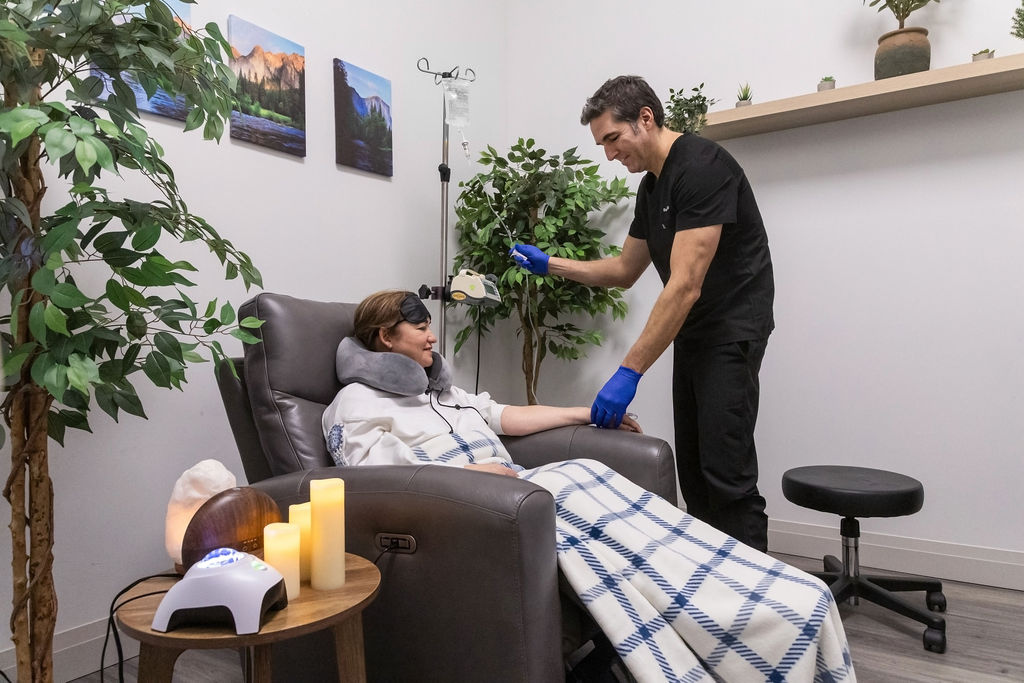
4.) Medically Supervised Infusion
Psychedelic infusions should be delivered under direct medical supervision, with patients monitored and supported throughout treatment by an expert doctor and a trauma-informed team.
5.) Integration and Follow-Up
After treatment, patients may need time and support to make sense of the experience. Integration can help connect treatment insights to real life. That could include therapy, journaling, behavioural changes, or simply going for a walk and reflecting on the experience.
Is Ketamine Approved for Depression in Canada?
Ketamine has been used in medicine for decades and is authorized in Canada as an anesthetic for diagnostic and surgical procedures. For mental health conditions such as treatment-resistant depression or PTSD, IV ketamine is generally considered an off-label treatment. Off-label prescribing is common in medicine. It means a physician may prescribe an approved medication for a condition not listed in the original Health Canada approval if they believe it is clinically appropriate.
Health Canada has also authorized esketamine nasal spray, sold as Spravato, for certain cases of moderate to severe major depressive disorder where patients have not responded to other antidepressants or where urgent psychiatric care is required.
When people are diagnosed with a treatment-resistant mental health condition, psychiatrists and health care providers will often suggest alternatives to antidepressants, such as ketamine therapy, as an option to consider. When treatment is administered by a doctor, it’s widely considered to be safe and effective.
Who May Be a Candidate for IV Ketamine Therapy?
IV ketamine therapy may be considered for adults with depression that has not improved enough with standard care.
This could include people who have:
- Tried two or more antidepressants without enough benefit
- Had side effects that made antidepressants hard to continue
- Been in therapy, but still feel persistently depressed
- Experienced repeated depressive episodes
- Felt emotionally numb, disconnected, or unable to move forward
- Struggled with depression alongside anxiety, trauma, or chronic stress
It may also be considered when a person feels they have done the expected things, such as taking medication, attending therapy, and making lifestyle changes, but still cannot regain a meaningful quality of life.
Who May Not Be a Good Candidate?
IV ketamine therapy is a highly effective treatment for mental health conditions such as depression, PTSD, or anxiety, but it’s not a good fit for everyone. There may be risks for people with:
- Uncontrolled high blood pressure
- Certain heart conditions
- Active psychosis
- History of mania or unstable bipolar disorder
- Active substance use disorder concerns
- Certain medication interactions
- Pregnancy or other medical considerations
- Unstable safety concerns that require urgent or hospital-based care
This is why screening and personalized care are the foundation of the treatment.
Why People in Toronto and Ontario Are Looking for Different Depression Options
Many people in Toronto and across Ontario face long waits to see a psychiatrist, fragmented care, and limited access to specialized mental health support. Some people have a family doctor but no psychiatrist. Others have a therapist but no medication review. Some have tried multiple medications but still feel lost.
This can leave people feeling like they are moving in circles.
They may be told to “give it more time,” “try another medication,” or “keep going to therapy,” even after years of limited progress.
For some people, that advice may be right. For others, it may be incomplete.
A better question is:
What has already been tried, what has not worked, and what does the evidence suggest could be considered next?
For people with treatment-resistant depression who are looking for alternatives to antidepressants, IV ketamine therapy may be one option to discuss as part of a broader care plan.
Frequently Asked Questions
1.) Are antidepressants ineffective?
No. Antidepressants help many people. But they don’t work well enough for everyone. Some people have partial improvement, side effects, relapse, or no meaningful response. That is why alternatives to antidepressants may be considered when depression persists after proper treatment.
2.) What are alternatives to antidepressants?
Alternatives may include structured therapy, sleep treatment, lifestyle supports, medication augmentation, and medically supervised treatments such as IV ketamine therapy. The right option depends on your diagnosis, treatment history, symptoms, and medical safety profile.
3.) Is IV ketamine therapy a replacement for therapy?
Not usually. IV ketamine therapy may work best when combined with preparation, integration, and ongoing support. Therapy can help people process insights and turn treatment experiences into practical changes.
4.) How fast does ketamine work for depression?
Some studies suggest that ketamine may improve depressive symptoms more quickly than traditional antidepressants for some people with treatment-resistant depression.
5.) Is IV ketamine therapy legal in Canada?
Ketamine is authorized in Canada as an anesthetic. IV ketamine for depression involves off-label use, which is legal and safe when prescribed, managed, and administered by a physician.
6.) Is ketamine safe?
When ketamine is administered in a controlled environment by an experienced physician, in the presence of a trauma-informed team, it is considered to be a safe and low-risk treatment option for mental health conditions and chronic pain.
Conclusion: You May Not Be Out of Options
If antidepressants and therapy have not been enough, it can feel like you are running out of options. But persistent depression doesn’t mean you are beyond help. It may mean your care needs to become more specific.
Antidepressants can be useful. Therapy can be valuable. Lifestyle changes can support recovery. But for some people, these steps do not fully relieve depression.
For adults in Toronto, the GTA, and across Ontario who are living with treatment-resistant depression, IV ketamine therapy may be worth exploring as part of a medically supervised treatment plan.
At Ketamind Health, the focus is on careful assessment, medical supervision, preparation, and integration. The goal is not to sell a quick fix. The goal is to help people who have been stuck find a safer, more supported path forward.
When to Seek Urgent Help
This article is educational and is not a substitute for emergency care.
If you are in immediate danger or need urgent medical support in Canada, call 911. If you are thinking about suicide or worried about someone else, call or text 9-8-8. Canada’s 9-8-8 Suicide Crisis Helpline is available 24 hours a day, every day of the year.
Do not wait for a routine appointment if there is active suicidal intent, psychosis, inability to eat or drink, severe confusion, or immediate risk of harm.
This content is provided for informational purposes only and should not be considered medical advice. Treatment decisions should always be made in consultation with a qualified healthcare provider. If you’d like to learn more about whether this approach may be appropriate for you, please speak with your doctor or contact Ketamind Health directly.