Many people begin researching psychedelic therapy after standard mental health treatment hasn’t worked well enough, and one of the first questions they ask is whether it’s legal in Canada. For many, the search begins after years of struggling with depression, PTSD, and anxiety.
Across Ontario, interest in psychedelic therapy has grown quickly. At the same time, many people are unclear about what’s legal, what’s medically available, and what questions to ask before considering treatment.
This article explains what’s legally available in Canada, what the evidence shows, and what to understand before speaking with a clinic or healthcare provider.
What Forms of Psychedelic Therapy Are Legal in Canada?
There are three legal psychedelic therapy pathways in Canada.
The most accessible option is physician-led IV psychedelic therapy delivered in a medical clinic. A physician can legally prescribe and administer this treatment for treatment-resistant depression, PTSD, anxiety disorders, and bipolar depression when it’s clinically indicated.
In Canada, this treatment is prescribed off-label. This means that a physician uses an approved medication for a condition beyond its original approval. This is common in Canadian medicine and happens across many areas of care.
The medication used in physician-led IV psychedelic therapy has been used in clinical practice for decades as an anesthetic and is listed by the World Health Organization as an essential medicine. It also has a stronger evidence base than other psychedelic therapy options currently available in Canada.
The second pathway is Health Canada’s Special Access Program. A healthcare practitioner can request access to certain restricted psychedelic substances for serious or treatment-resistant conditions when conventional treatments have failed. This option is typically slow, expensive, and not easily available for most people.
The third option is through a clinical trial. These studies allow access to certain restricted substances under research conditions, with screening, consent, monitoring, and strict oversight. Admission is competitive and depends on which trials are currently running.
For most people in Ontario who haven’t improved enough through medication and therapy, physician-led IV psychedelic therapy is the most established legal option available.
The Evidence Behind Legal Physician-Led IV Psychedelic Therapy
Not all psychedelic treatments are at the same stage of medical evidence.
Physician-led IV psychedelic therapy uses a medication that has been studied in medical settings for decades. It has known effects on the brain and body, established dosing practices, and a large safety record when used by trained clinicians.
That’s different from newer psychedelic therapies, where early research is promising but still developing. For those treatments, researchers are still studying who benefits most, what dose is appropriate, how often treatment should happen, and what long-term effects need monitoring.
This is part of what makes physician-led IV psychedelic therapy the most legally accessible and evidence-supported option in Canada right now.
What Are the Risks of Psychedelic Therapy?
Psychedelic treatments can affect people differently based on trauma history, bipolar risk, current medications, heart health, anxiety sensitivity, and psychological state.
Possible effects include anxiety, dissociation, confusion, perceptual changes, increased blood pressure or heart rate, emotional distress, impaired judgment, and worsening symptoms.
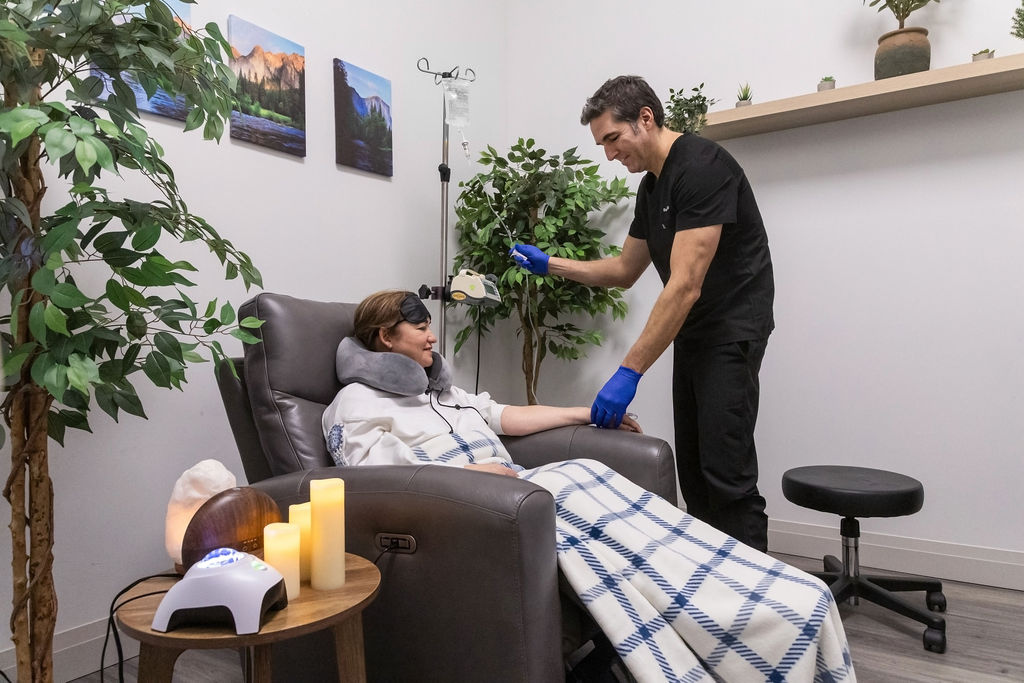
These risks emphasize the importance of treatment being done in an accredited Canadian clinic, with an experienced physician available at all times, a trauma-informed care team, and a calming setting.
Why Physician-Supervised Psychedelic Therapy Produces Better Outcomes
Physician-supervised care helps turn the effects of psychedelic medicine into a mental health treatment.
That means choosing a reputable clinic, with an experienced doctor and care team who can customize a treatment plan for you and support you before, during and after your treatment.
Medical supervision lowers risk. When a doctor is present to administer the treatment, they can address any concerns that arise, such as changes in vital signs or emotional shifts that could occur during the session.
A study published by the National Institute of Health found that medical screening, monitoring, and physician involvement are what separate a safe clinical outcome from a dangerous one. Legal, physician-supervised treatment doesn’t just lower the risk. It also improves the outcome.
Why the Legal Framework Around Psychedelic Therapy Exists in Canada
A treatment becomes part of medical practice through evidence, clinical judgment, and safety standards.
Physician-led IV psychedelic therapy works through a different pathway in the brain than traditional antidepressants. A 2023 trial published in The New England Journal of Medicine found it to be as effective as electroconvulsive therapy (ECT) for treatment-resistant depression, with fewer effects on memory and thinking. A review in the American Journal of Psychiatry found strong evidence for rapid improvement in people who hadn’t responded to other treatments
Psychedelic therapy is not a new treatment. In fact, there is substantial evidence supporting its use for mental health conditions for over 25 years.
Is Psychedelic Therapy Right for You?
People begin to explore psychedelic therapy options when they have not responded enough to typical mental health treatments, such as medication and therapy.
If this is you, or someone you love, and you are still struggling with the symptoms of a mental health condition, it could be an option worth exploring.
Please contact Ketamind Health at (416) 343-0074 to see if you qualify for treatment.
Frequently Asked Questions About Legal Psychedelic Therapy in Canada
- Is psychedelic therapy covered by OHIP?
Treatment fees aren’t generally covered by OHIP. A portion may be covered by some private insurance plans, depending on the plan and the treatment.
- Is psychedelic therapy safe when delivered legally?
Physician-led IV psychedelic therapy has a well-established safety record when delivered by a trained physician in a clinical setting. The medication has been used safely in medical settings for over 50 years and is considered to be a low-risk treatment.
- Do I need a referral?
Many clinics allow people to book a consultation directly. You’ll be asked to provide your medical history and complete an assessment before determining whether this treatment is a good fit for you.
- How many sessions does it take to start to feel better?
Most treatment plans involve a series of sessions. The number depends on your response, though most people will have around 6 treatment sessions at the start of treatment followed by maintenance. See our treatment process overview for more details.
- Is legally available psychedelic therapy evidence-based?
Yes. Physician-led IV psychedelic therapy has been studied extensively for treatment-resistant depression and related conditions. A 2023 trial in The New England Journal of Medicine found it to be as effective as ECT with fewer cognitive side effects. The evidence base is stronger than other psychedelic therapies currently available outside research settings in Canada.
- How is IV psychedelic therapy different from other psychedelic treatments?
IV psychedelic therapy is the most precise and controlled legal delivery method, allowing the physician to adjust and personalize the treatment plan. Other psychedelic treatments in Canada remain largely restricted to clinical trials or the Special Access Program.
- What should I look for in a legal psychedelic therapy clinic in Ontario?
If you are looking into this treatment, it’s important to ask the clinic who actually supervises and administers the treatment, what their medical qualifications are, what screening is required, how risks are monitored, what the room setting is like, and what follow-up is included in care. It’s also important to know whether the treatment is administered in an accredited medical facility, which in Ontario is an OHP (out-of-hospital premises) level 2 facility. You should look for a clinic that has an experienced physician on site to administer and monitor the treatment, a trauma-informed care team, the highest safety standards and monitoring procedures, as well as a calming environment.
What to Know Before Starting Legal Psychedelic Therapy in Canada
For people with treatment-resistant depression, PTSD, or anxiety, the key is understanding which treatments are legally available, which remain restricted, and what safety standards should be in place before treatment begins.
If you’re ready for treatment built on evidence, not trial and error, book a consultation to see if this could be a fit.Book your free consultation here
About the Author
This article was written by Dr. Darren Ezer, MD, Royal College-certified anesthesiologist, Associate Professor at Toronto Metropolitan University, and Medical Director of Ketamind Health in Markham, Ontario. Dr. Ezer has advanced expertise in IV psychedelic infusion therapy for mental health and chronic pain, and brings an active research perspective to every aspect of care at Ketamind Health. Psychiatric assessment is overseen by Dr. Brian Kirsh, a psychiatrist. Meet our team.
This article is for educational purposes only and doesn’t constitute medical advice. Treatment decisions should be made in consultation with a qualified healthcare professional.
References
Paper titles appear as published in peer-reviewed journals.
- [1] World Health Organization. (2023). WHO Model List of Essential Medicines, 23rd Edition. https://www.who.int/publications/i/item/WHO-MHP-HPS-EML-2023.02
- [2] Government of Canada. Controlled Drugs and Substances Act (S.C. 1996, c. 19). https://laws-lois.justice.gc.ca/eng/acts/C-38.8/
- [3] Anand, A., et al. (2023). Ketamine versus ECT for Nonpsychotic Treatment-Resistant Major Depression. New England Journal of Medicine, 388(25), 2315-2325. https://doi.org/10.1056/NEJMoa2302399
- [4] Murrough, J.W., et al. (2021). Synthesizing the Evidence for Ketamine and Esketamine in Treatment-Resistant Depression. American Journal of Psychiatry, 178(5), 383-399. https://pubmed.ncbi.nlm.nih.gov/33726522/
- [5] Snowdon, D.A., et al. (2017). Does clinical supervision of healthcare professionals improve the effectiveness of care and patient experience? A systematic review. https://pmc.ncbi.nlm.nih.gov/articles/PMC5706384/
- [6] Rush, A.J., et al. (2006). Acute and Longer-Term Outcomes in Depressed Outpatients Requiring One or Several Treatment Steps: A STAR*D Report. American Journal of Psychiatry, 163(11), 1905-1917. https://doi.org/10.1176/ajp.2006.163.11.1905
- [7] Murrough, J.W., et al. (2013). Antidepressant Efficacy of Ketamine in Treatment-Resistant Major Depression: A Two-Site Randomized Controlled Trial. American Journal of Psychiatry, 170(10), 1134-1142. https://doi.org/10.1176/appi.ajp.2013.1303039